
1:28 understand how to carry out calculations involving amount of substance, relative atomic mass (Aᵣ) and relative formula mass (Mᵣ)
The following formula allows for the interconversion between a mass in grams and a number of moles for a given substance:
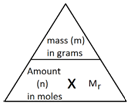
\[Amount(mol) = \frac{mass(g)}{M_r} \]
Example 1:
Calculate the amount, in moles, of 8.8 g of carbon dioxide (CO2).
Step 1: Calculate the relative formula mass (Mr) of carbon dioxide (CO2).
\[Carbon\,dioxide = CO_2 \] \[Atoms\,present = (1 \times C) + (2 \times O) \] \[M_r = (1 \times 12) + (2 \times 16) = 44 \]
Step 2: Use the formula to calculate the amount in moles.
\[Amount = \frac{mass(g)}{M_r} \] \[Amount = \frac{8.8}{44} \] \[Amount = 0.2 mol \]
Example 2:
Calculate the mass of 2 mol of copper(II) sulfate (CuSO4).
Step 1: Calculate the relative formula mass (Mr) of copper(II) sulfate (CuSO4).
\[copper(II)\,sulfate = CuSO_4 \] \[Atoms\,present = (1 \times Cu) + (1 \times S) + (4 \times O) \] \[M_r = (1 \times 63.5) + (1 \times 32) + (4 \times 16) = 159.5 \]
Step 2: Rearrange the formula to calculate the mass.
\[mass = amount \times M_r \] \[mass = 2 \times 159.5 \] \[mass = 319g\]