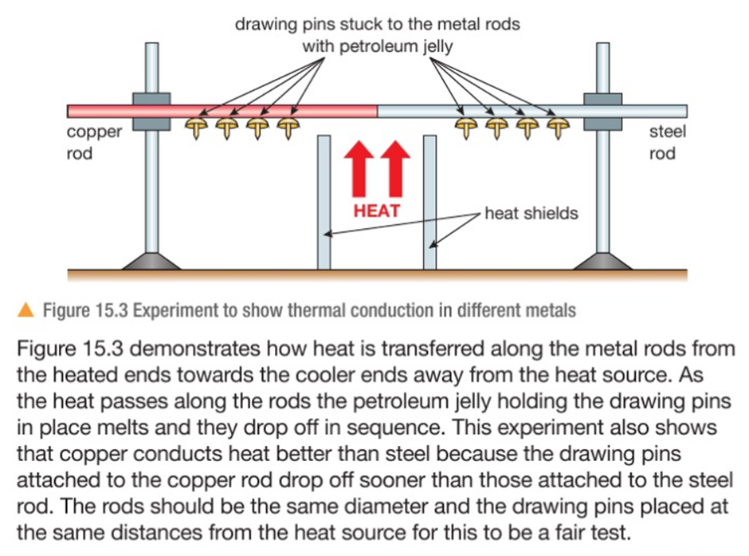
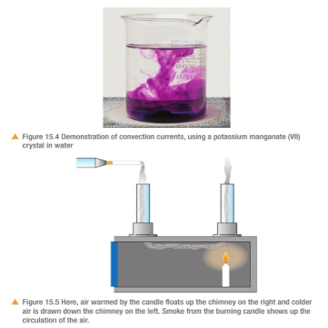
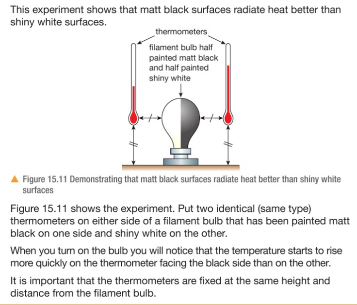
4.09 practical: investigate thermal energy transfer by conduction, convection and radiation

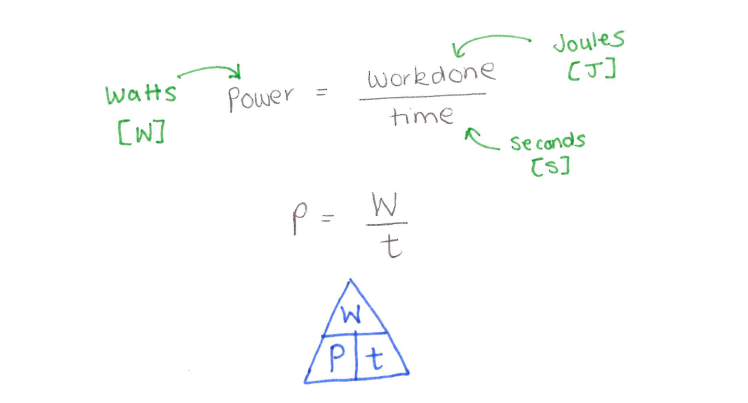
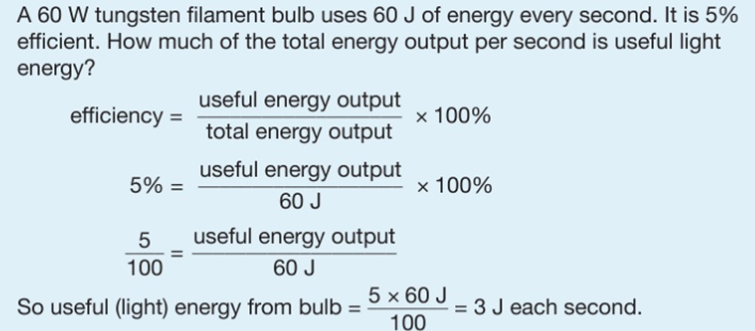
power is the rate of transfer of energy, or the rate of work done. so p = E/t
Because energy is conserved the decrease in GPE = increase in KE, for a falling object if no energy is lost to the surroundings
Kinetic energy (J) = 0.5 x mass (kg) x velocity (m/s) 2
Gravitational potential energy (J) = Mass (kg) x gravitational field strength (N/kg) x height (m)
|
Work done = energy transferred |
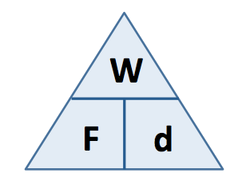
Work Done (J) = Force (N) x distance moved (m)
A good insulating material is a poor conductor that contains trapped air, e.g. foam, feathers, glass fibre. Being a poor conductor (non-metal) prevents heat transfer by conduction and the trapped air prevents convection currents.
|
– Light, shiny surfaces are good reflectors of IR and so are poor at absorbing it. – Dark, matt surfaces are poor reflectors and good at absorbing IR. – This means that placed next to a heat source, a dark object would heat up faster than a light one. – Dark matt surfaces are also best at emitting IR. This means that a hot object with a light shiny surface will emit less IR than a dark matt object at the same temperature. – Hotter objects emit more IR per second. The type of EM wave emitted also changes with temperature – the higher the temperature the higher the frequency of EM wave emitted. |
Conduction is the transfer of thermal energy through a substance by the vibration of the atoms within the substance. Metals are good conductors because they have free electrons that can move easily through the metal, making the transfer of energy happen faster.
Convection occurs in a liquid or gas. These expand when heated because the particles move faster and take up more volume – the particles remain the same size but become further apart. The hot liquid or gas is less dense, so it rises into colder areas. The denser, colder liquid or gas falls into the warm areas. In this way, convection currents are set up which transfer heat from place to place.
Thermal radiation is the transfer of energy by infrared (IR) waves. These travel very quickly in straight lines.
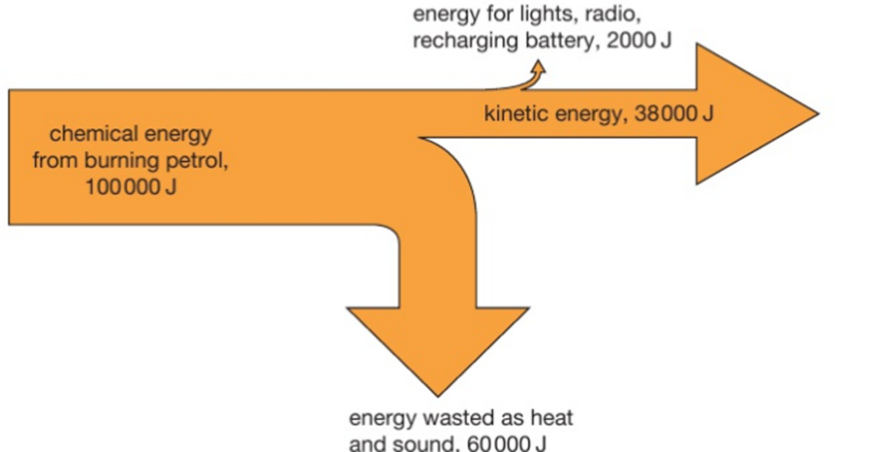
The energy flow is shown by arrows whose width is proportional to the amount of energy involved. The wasted and useful energy outputs are shown by different arrows.
In any process energy is never created or destroyed. (It is just transferred from one store to another.)
|
Energy Stores: Chemical – e.g. the food we eat Kinetic – movement energy Gravitational – objects that are lifted up Elastic – e.g. from springs Thermal – from hot objects Magnetic – objects in magnetic fields Electrostatic – charged objects Nuclear – stored within a nucleus
|
know the units for
Mass = kilogram (kg)
energy = joule (J)
velocity = metre/second (m/s)
acelleration = metre/ second 2 (m/s2)
force = newton (N)
time = second (s)
power = watt (W)