Physics

8.14 describe evidence that supports the Big Bang theory (red-shift and cosmic microwave background (CMB) radiation)

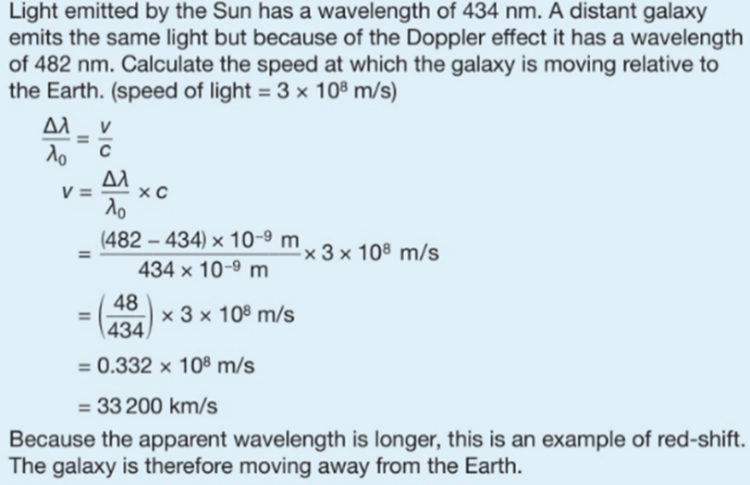
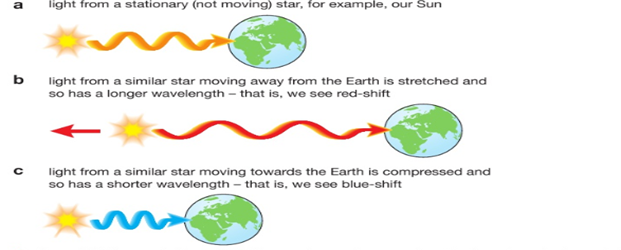
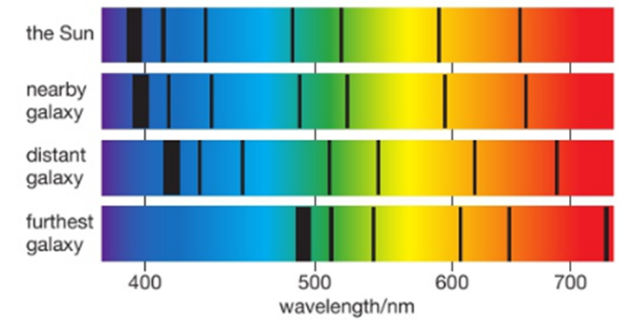
If we examine the light spectra for distant galaxies we can see that the wavelengths of the light have become longer. We call this stretching of the waves ‘red-shift’. It tells us that the galaxies producing the light are moving away from us .The further away a galaxy is, the greater its red-shift, so it is moving even faster. This is evidence that the Universe is expanding and so it supports the Big Bang Theory.


Microwave radiation can be detected EVERYWHERE in the Universe. These are the stretched remains of high energy gamma radiation that would have been produced in the explosion that created the Universe. They have stretched because the Universe is expanding.

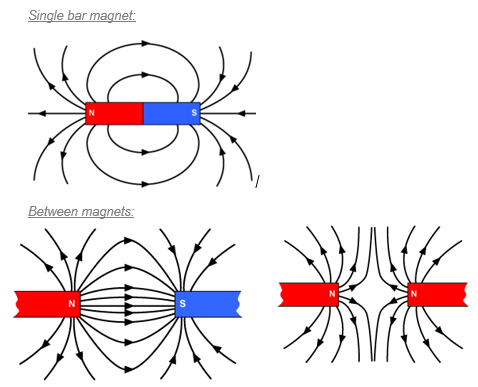
6.06 practical: investigate the magnetic field pattern for a permanent bar magnet and between two bar magnets

  1. Place your bar magnet in the centre of the next page and draw around it.
  2. Place a compass at one pole of the bar magnet.
  3. Draw a ‘dot’ to show there the compass is pointing,
  4. Move the compass so the opposite end of the needle is pointing to the dot,
  5. Repeat steps 3 and 4 until to reach the other pole of the magnet.
  6. Do this procedure at least 5 times from different points on the pole of the magnet.
    *Tip, try to be as accurate as possible when drawing your dots*
  7. Join up your dots to create the field line plots

5.14 practical: investigate the specific heat capacity of materials including water and some solids

  1. Set up the apparatus as shown the diagram.
  2. Make note of all measurements: current (A), potential difference (V), mass (kg).
  3. Use the electronic balance to measure the mass of your
  4. Record the initial temperature of you block.
  5. Switch on the heater and start your stopwatch.
    [You will now leave the heater on for 10 minutes]
  6. While the heater is switched on take readings from the
    Ammeter and the Voltmeter.
  7. Use these to calculate the Thermal Energy that will be
    supplied to the block in 10 minutes
  8. Record the temperature of your block after 10 minutes.
  9. Calculate the Change in Temperature

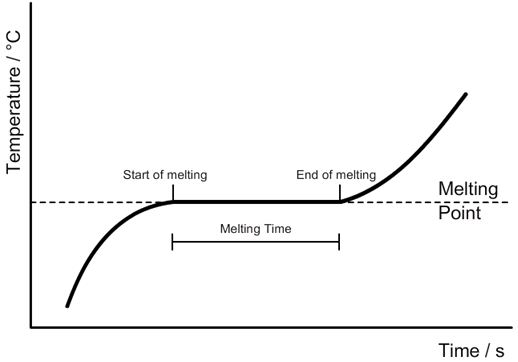
5.11 practical: obtain a temperature–time graph to show the constant temperature during a change of state

  1. Remove the boiling tube of stearic acid from
    the water bath
  2. Place the tube into a beaker of room
    temperature water
  3. Add a separate thermometer to the water
  4. Take readings from the thermometer in the
    stearic acid and the water every minute
    [Make sure to avoid parallax error while doing so]
  5. Note readings in the table below
  6. Note on the table when you observe the stearic
    acid change from a liquid to a solid.
  7. Plot your results in a graph

3.19 practical: investigate the refractive index of glass, using a glass block

1.       Set up your apparatus as shown in the diagram using a rectangular block.

2.       Shine the light ray through the glass block

3.       Use crosses to mark the path of the ray.

4.       Join up crosses with a ruler

5.       Draw on a normal where the ray enters the glass block

6.       Measure the angle of incidence and the angle of refraction and add these to your results table

7.       Calculate the refractive
index

8.       Repeat steps 2 – 7 using
a different angle of
incidence

9.       Find an average of your
results.


3.17 practical: investigate the refraction of light, using rectangular blocks, semi-circular blocks and triangular prisms

1.       Set up your apparatus as shown in the diagram using a rectangular block.

2.       Shine the light ray through the glass block

3.       Use crosses to mark the path of the ray.

4.       Join up crosses with a ruler

5.       Draw on a normal where the ray enters the glass block

6.       Measure the angle of incidence and the angle of refraction and add these to your results table

7.       Comment on how the speed of the light has changed as the light moves between the mediums.

8.       Repeat this for different angles of incidence and different glass prisms. 

2.23 practical: investigate how insulating materials can be charged by friction

  • Hold polythene rod and cloth next to up small pieces of paper one at a time, observe.
  • Now rub the rod with the cloth
  • Again hold close to small pieces of paper, observe.
  • Turn on a tap so a thin stream of water is flowing
  • Hold the rod about 1cm away from the water just below the nozzle, observe
  • Repeat with different material rods and cloths

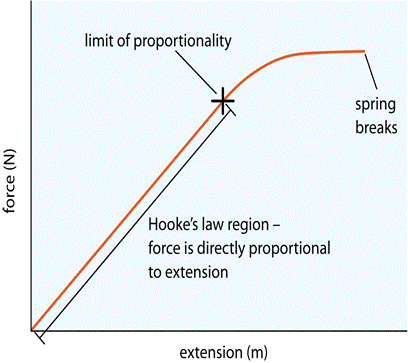
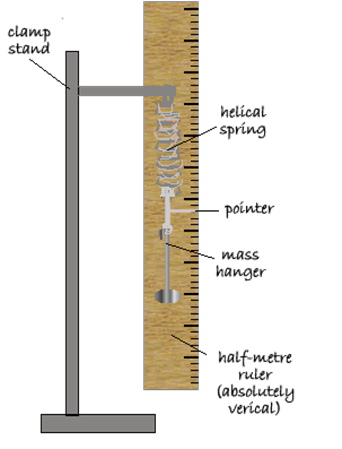
1.22 practical investigate how extension varies with applied force for helical springs, metal wires and rubber bands

  1. Set up your apparatus as shown in the
  2. Measure the length of your spring without
    any hanging masses.
  3. Hang a mass of 100g on the spring
  4. Measure the new length of the spring
  5. Calculate the extension of the spring
  6. Repeat steps 3-5 for increasing the mass
    in increments of 100g
  7. Take note of your results in the table.

8.15 describe that if a wave source is moving relative to an observer there will be a change in the observed frequency and wavelength

This is called the Doppler Effect. If something that emits a wave moves whilst it is doing so (imagine a noisy motorbike coming towards you then going further away, emitting sound waves the whole time) then the wavelength of the sound will become shorter as it is moving towards you, increasing the frequency, and  stretched as it is moving away, decreasing the frequency.


You will hear this as a change in pitch, getting higher as it approaches and lower as it moves away. The same thing happens for a moving object that is emitting light waves –e.g. a galaxy.

8.13 describe the past evolution of the universe and the main arguments in favour of the Big Bang

Scientists believe that about 14 billion years ago all matter in the Universe was in one extremely tiny and dense place. It then suddenly exploded, and has been expanding ever since. This expansion is shown by the red-shift of galaxies and the energy of the explosion can be seen everywhere in the Universe as the CMBR.

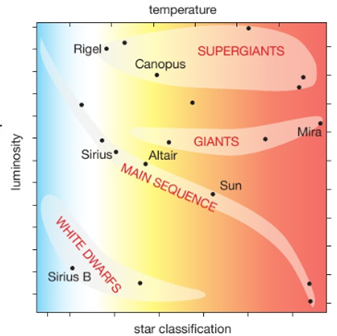
8.12 draw the main components of the Hertzsprung–Russell diagram (HR diagram)

This diagram shows the relationship between a star’s luminosity (its brightness or power output) and its surface temperature. A star moves to different positions in the diagram during its life, as its internal structure and temperature change.


Important Note: the temperature scale is reversed. It is hotter towards the origin of the x axis.

8.11 understand how the brightness of a star at a standard distance can be represented using absolute magnitude

Apparent magnitude is simply how bright a star appears in the night sky.


But, the brightness of a star depends on its distance from Earth and its luminosity – how much power it produces. (A dim star could just be very far away, or very close but not very luminous).


Absolute magnitude enables us to compare the brightness of stars because it is a measure of how bright they would appear if they were all the same distance from the Earth. – 32.6 light years.

8.10 describe the evolution of stars with a mass larger than the Sun

After the stable period, a giant star expands into red supergiant. (It produces all the elements up to iron during nuclear fusion). When it finally runs out of nuclei to fuse it collapses due to the gravitational force, and then explodes – an exploding star is called a supernova.


The explosion throws dust and gas back into space and so another nebula is formed. A dense core remains – called a neutron star, because it is made entirely from neutrons. If its mass is large enough it can compress further to become a black hole. (Their gravity is so strong that not even light can escape!)

8.09 describe the evolution of stars of similar mass to the Sun through the following stages: nebula, star (main sequence) , red giant, white dwarf

• nebula

Stars form from large clouds of dust and gas particles (nebulae) that are drawn together by gravitational forces over millions of years. As the particles get closer the temperature and pressure becomes so large that nuclear fusion of hydrogen nuclei to helium nuclei occurs.  This releases enormous amounts of energy in the form of heat and light.


• star (main sequence)

Fusion produces forces that make the star expand outwards, but gravitational force is always pulling the particles within the star inwards. When these two opposing forces become balanced a star is stable and called a main sequence star. It should stay this way for millions of years, at a constant size and temperature.


• red giant

Eventually hydrogen fusion stops as the star runs out of fuel. Gravitational force is now bigger than the outward fusion force which causes the star to collapse inwards and compress. This causes it to heat up to even higher temperatures so that fusion of helium nuclei begins. The increased power output causes the star to expand greatly. The surface area is so large that it is cooler than before, so its colour changes to red and the star is called a red giant.


• white dwarf

Eventually fusion stops when the star runs out of helium nuclei and the gravitational force causes the star to collapse inwards and compress again. This heats it up so it changes colour to emit white light. The star is squashed so greatly by the gravitational force to become a small and very dense white dwarf. (They are so dense that a teaspoon full would weigh more than a cruise liner). A white dwarf eventually cools down and change colour as it does so, eventually becoming black.

8.08 know that a star’s colour is related to its surface temperature

Stars are classified into 7 groups according to their colours (which is due to their surface temperature); O,B,A,F,G,K,M

O are hottest (> 33 000 K and blue), M are coolest (2000 – 3700K and red)

8.05 describe the differences in the orbits of comets, moons and planets

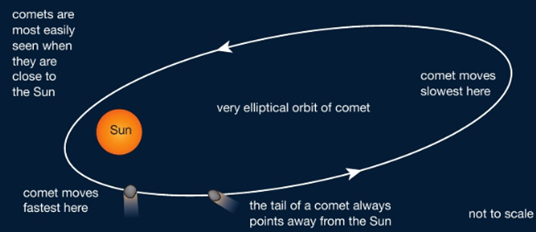
Comets have highly elliptical orbits, with the Sun at one focus. When they come in close to the Sun they speed up, due to the larger gravitational force on them. They also develop bright tails that point away from the centre of the Sun. These are caused by tiny ice crystals that melt and break off from the comet and reflect the bright light of the Sun.

Moons have circular orbits and planets orbit in slightly squashed circles, called ellipses. 

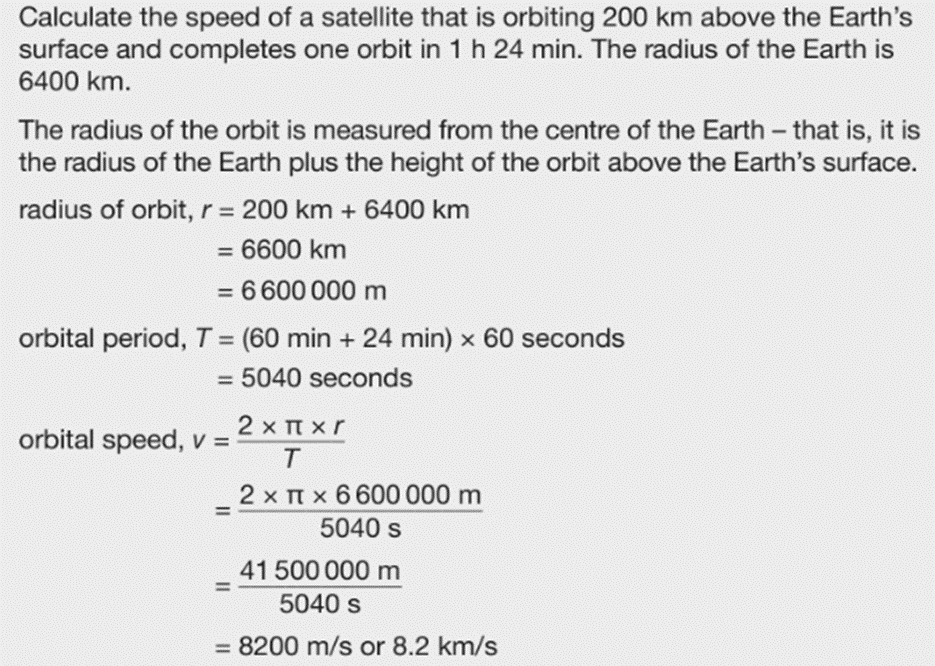
8.04 explain that gravitational force: causes moons to orbit planets, causes the planets to orbit the Sun, causes artificial satellites to orbit the Earth, causes comets to orbit the Sun

According to Newton, there is an attractive gravitational force between any two objects– pulling them together. E.g. the planets and comets experience an attractive force towards the Sun.

Moons and artificial satellites are attracted to their planets, and so are pulled towards them.

This gravitational force keeps them moving in curved paths called orbits. The Moon does not crash into the Earth, and the planets do not crash into the Sun because they are moving.

8.03 understand why gravitational field strength, g, varies and know that it is different on other planets and the Moon from that on the Earth

An object’s gravitational field strength depends on its MASS. A massive object, like a star, will have a very large g-field. The Moon has less mass than the Earth, so its gravitational field is much weaker – approx 1/6th of the Earth’s. This means that we could jump higher on the Moon, and objects would fall more slowly, as they experience a weaker gravitational force.


A planet with a large radius will have a weaker gravitational field at its surface, because the surface is further away from the centre of the planet.

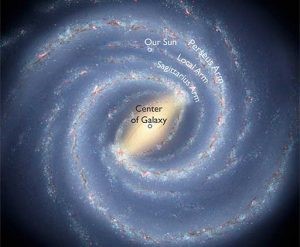
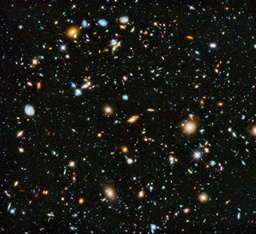
8.02 know that: the universe is a large collection of billions of galaxies, a galaxy is a large collection of billions of stars, our solar system is in the Milky Way galaxy

The  Milky Way galaxy contains billions of stars

The Universe – billions of galaxies

8.01 use the following units: kilogram (kg), metre (m), metre/second (m/s), metre/second2 (m/s2), newton (N), second (s), newton/kilogram (N/kg)

units for:

Mass: kilogram (kg)

distance: metre (m)

velocity: metre per second (m/s) 

acceleration: metre per second squared (m/s2)

Force: newton (N)

time: second (s)

gravitational field strength: newton/kilogram (N/kg) 


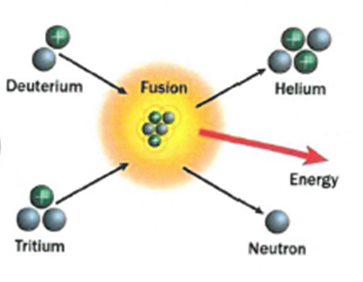
7.26 explain why nuclear fusion does not happen at low temperatures and pressures, due to electrostatic repulsion of protons

  • For nuclear fusion to occur, very high temperatures are required to overcome the repulsive force between the positively charged nuclei of each isotope.
  • High pressures are also needed to increase the chance of fusion between the nuclei.

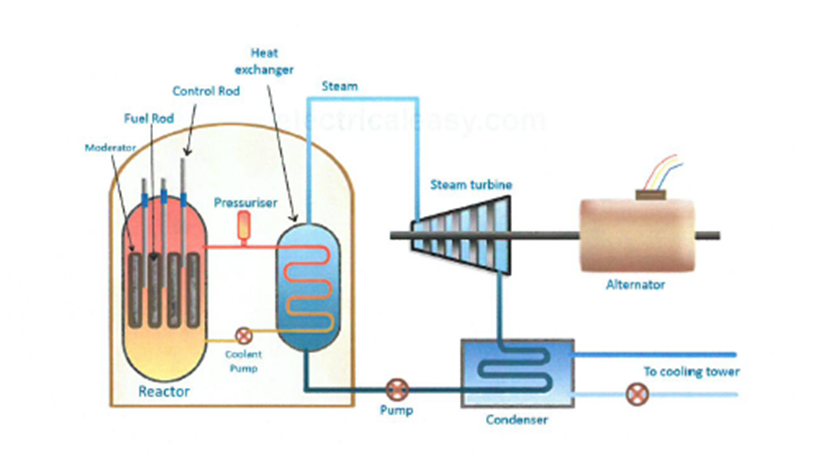
7.21 describe the role played by the control rods and moderator in the fission process

Moderator:

  • Graphite is used as a moderator.
  • The purpose of the moderator is to absorb some of the kinetic energy of the neutrons to slow them down.
  • This is because slow neutrons are more easily absorbed by uranium 235 nuclei.


Control rods:

  • Made of boron or cadmium.
  • The purpose of the control rods is to absorb neutrons and completely remove them from the fission process.
  • Helps adjust the rate of nuclear fission in the reactor.

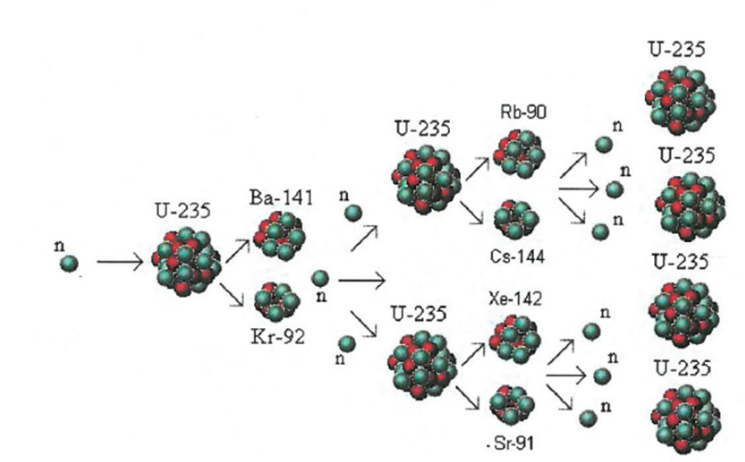
7.20 describe how a chain reaction can be set up if the neutrons produced by one fission strike other U-235 nuclei

Chain Reaction:

  • The three neutrons produced by the fission may hit other nuclei of uranium 235, causing the process to repeat.
  • For a chain reaction to occur, there is a minimum mass of uranium 235 required. This is known as the critical mass.

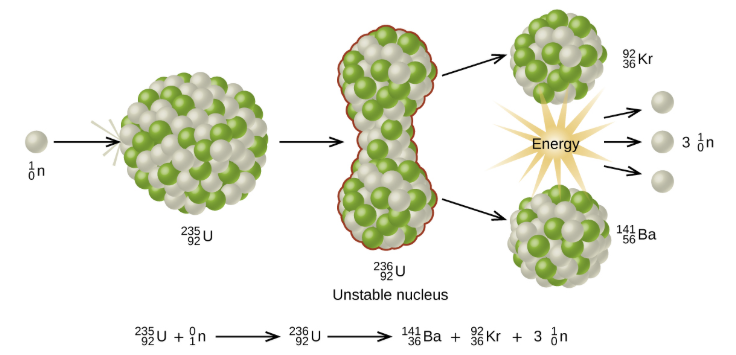
7.19 know that the fission of U-235 produces two radioactive daughter nuclei and a small number of neutrons

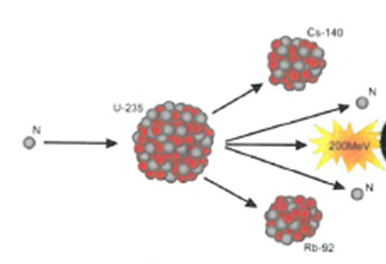
  • A slow moving neutron is absorbed by a uranium 235 nucleus.
  • The resulting uranium 236 nucleus is unstable.
  • It splits to form two smaller daughter nuclei, three neutrons and gamma radiation.

7.17 know that nuclear reactions, including fission, fusion and radioactive decay, can be a source of energy

  • Nuclear Fission:

The process where heavy atoms are split into smaller, lighter atoms. This releases energy.

  • Nuclear Fission:

The process where lighter atoms are forced to join together to make heavier atoms. This releases energy.

  • Radioactive Decay:

Within the core of the Earth, radioactive isotopes of elements such as uranium, thorium and potassium provide a large proportion of the heat within the Earth through radioactive decay.

7.16 describe the dangers of ionising radiations, including: that radiation can cause mutations in living organisms, that radiation can damage cells and tissue, the problems arising from the disposal of radioactive waste and how the associated risks can be reduced.

7.15 describe the difference between contamination and irradiation

  • Contamination:

Occurs when material that contains radioactive atoms is deposited on materials, skin, clothing, or any place where it is not desired.


  • Irradiation:

The process by which an object is exposed to radiation.

7.14 describe uses of radioactivity in industry and medicine

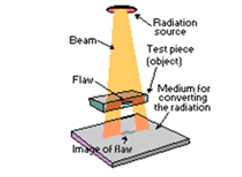
Gamma radiography:

Medical tracer:

–          Radioactive tracer put in body (swallowed/injected)

–          Detector put around body

–          Computer generates an image

Gauging:

–          Coal absorbs a lot of radiation

–          If only a small amount of radiation is detected back after it is reflected by what you are trying to gauge, lots of coal is present.

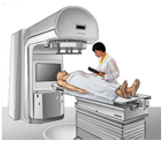
Radiotherapy

  • High doses of radiation are directed at cancer cells
  • Cancer cells are killed

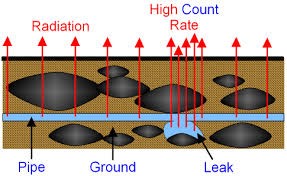
Pipe tracers:

–           A radioactive material which emits gamma radiation with a short half-life is put in the water

–          A detector is placed above the pipe

–          A spike in detected radioactivity suggests a leak in the pipe

Sterilisation:

  • Medical equipment irradiated
  • Kills all living matter on tools (e.g. bacteria)

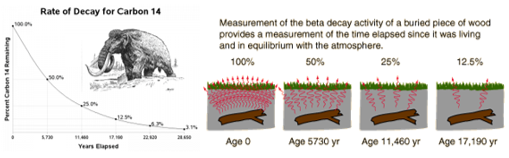
Carbon dating:

7.13 use the concept of the half-life to carry out simple calculations on activity, including graphical methods

Numerical:

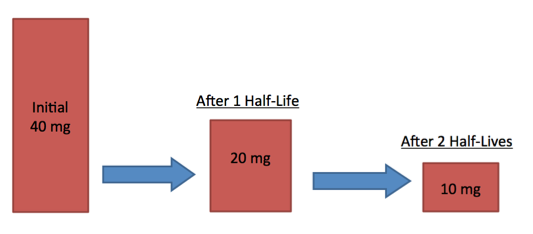
A radioactive source has a half-life of 2 hours. If the mass starts at 40mg, what will the mass be after 4 hours?


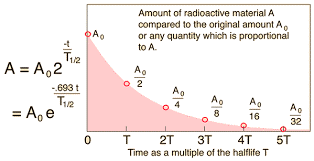
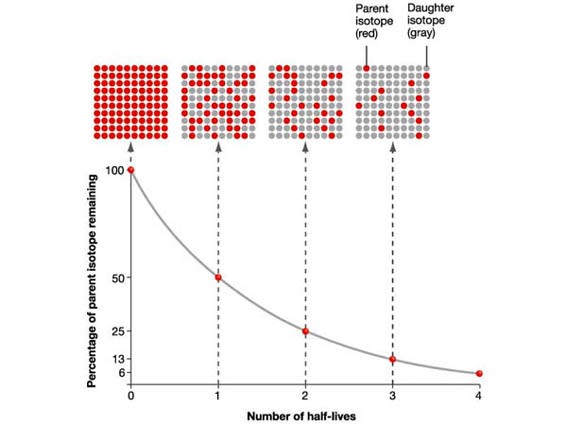
Graphical:

Several different times for the half-life can be calculated and averaged.

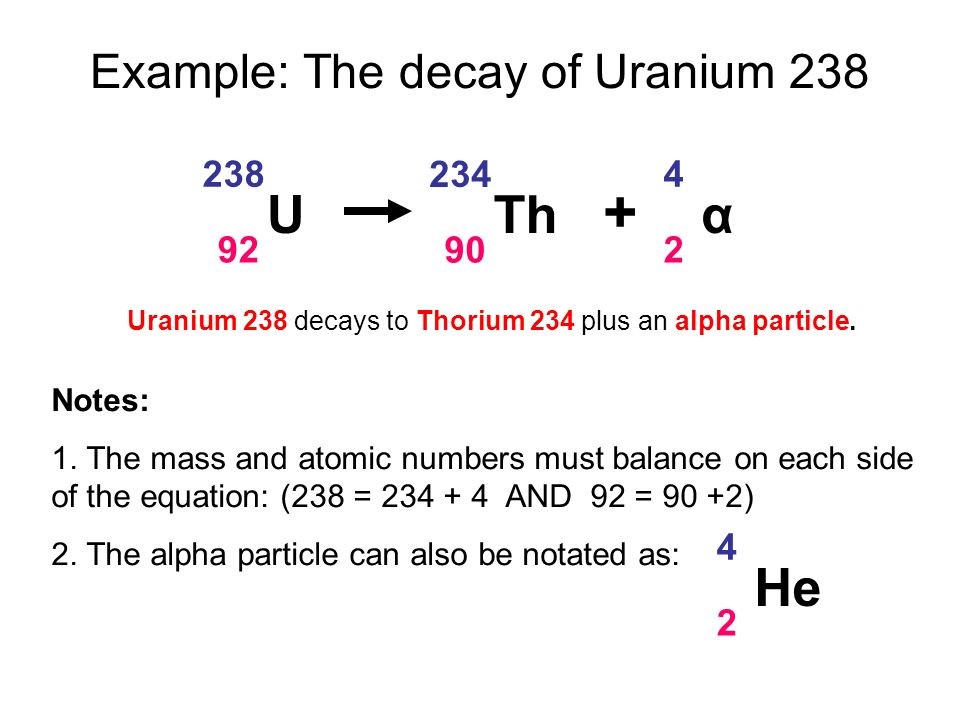
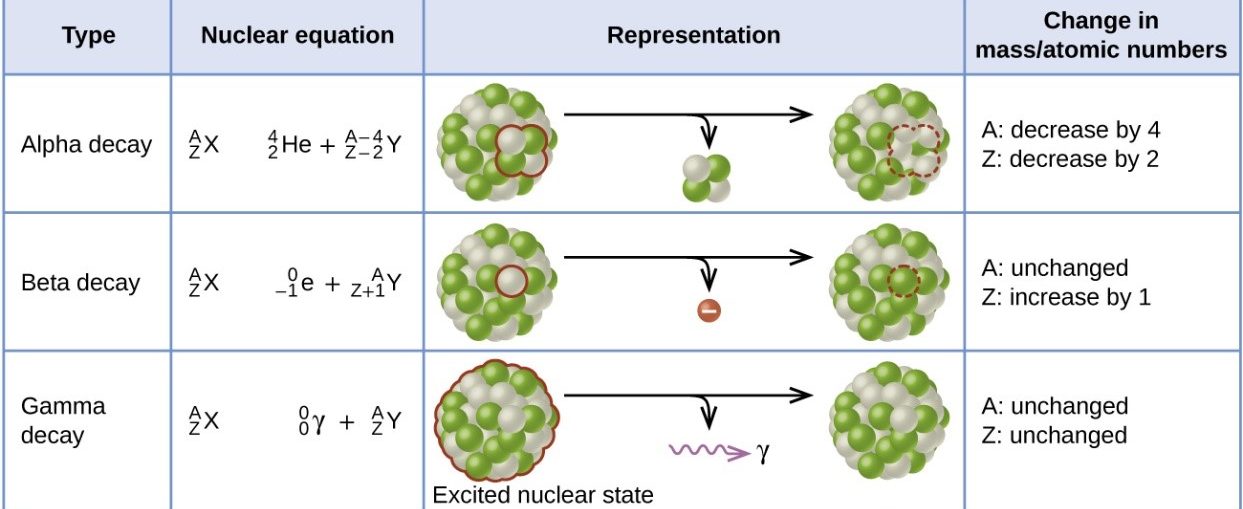
7.07 describe the effects on the atomic and mass numbers of a nucleus of the emission of each of the four main types of radiation (alpha, beta, gamma and neutron radiation)

Alpha decay:

·         2 protons and 2 neutrons are lost.

·         Mass number decreases by 4

·         Atomic number decreases by 2

Beta decay

·         1 neutron is converted to an electron (lost from the atom) and proton

·         Mass number is unchanged

·         Atomic number increases by 1

Gamma decay

·         Energy is lost from an atom in the form of an electromagnetic wave

·         Mass number is unchanged

·         Atomic number is unchanged

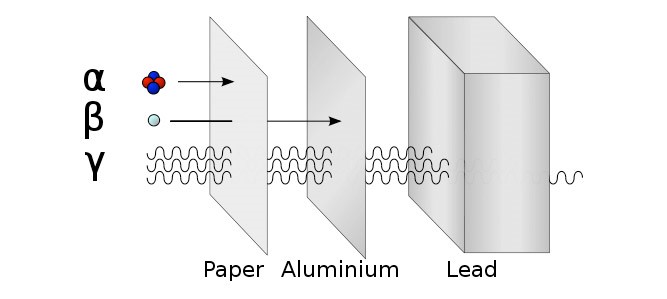
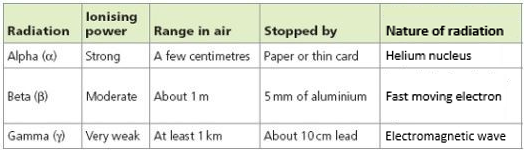
7.06 practical: investigate the penetration powers of different types of radiation using either radioactive sources or simulations

Detect using a Geiger Müller Tube.

Try the three different materials in order, paper then aluminium then lead.

Count rate will significantly decrease if radiation is stopped.

7.04 know that alpha (α) particles, beta (β−) particles, and gamma (γ) rays are ionising radiations emitted from unstable nuclei in a random process

There are three types of ionising radiation:

Alpha (α), Beta (β) and Gamma (γ)

One radioactive source can release different types of radiation.

Ionisation is when an atom loses or gains an electron, causing it to become an ion (an atom which is positively or negatively charged).

Select a set of flashcards to study:

     Terminology

     Skills and equipment

     Remove Flashcards

Section 1: Principles of chemistry

      a) States of matter

      b) Atoms

      c) Atomic structure

     d) Relative formula masses and molar volumes of gases

     e) Chemical formulae and chemical equations

     f) Ionic compounds

     g) Covalent substances

     h) Metallic crystals

     i) Electrolysis

 Section 2: Chemistry of the elements

     a) The Periodic Table

     b) Group 1 elements: lithium, sodium and potassium

     c) Group 7 elements: chlorine, bromine and iodine

     d) Oxygen and oxides

     e) Hydrogen and water

     f) Reactivity series

     g) Tests for ions and gases

Section 3: Organic chemistry

     a) Introduction

     b) Alkanes

     c) Alkenes

     d) Ethanol

Section 4: Physical chemistry

     a) Acids, alkalis and salts

     b) Energetics

     c) Rates of reaction

     d) Equilibria

Section 5: Chemistry in industry

     a) Extraction and uses of metals

     b) Crude oil

     c) Synthetic polymers

     d) The industrial manufacture of chemicals

Go to Top