https://robuchonlondon.co.uk/

https://www.allnetwork.org/kontak/

https://www.chicagoiron.com/

https://slopega.me/

slot qris

situs slot

slot qris

situs toto

situs toto

situs toto

gemilang77

https://campingrozenhof.com/

situs toto

https://prolugar.fau.ufrj.br/

situs toto

slot gacor qris

slot deposit 5000

toto togel

toto togel

situs togel

situs toto

slot qris

situs toto

situs toto

toto 4d

situs togel

deposit 5000

slot 5000

Situs toto

situs toto

situs toto

toto 4d

https://gallery.pustovit.com/

https://www.hoteldenver.net/

https://marywshelley.com/

otherPost Archives - TutorMyself Chemistry

otherPost

Tricks for remembering the names of organic molecules

A good way to remember the names of organic molecules is to make up a silly mnemonic where the first letter of each word matches the first letter of the organic molecules. For example the first 10 alkanes in order are , Methane, Ethane, Propane, Butane, Pentane, Hexane, Heptane, Octane, Nonane and Decane. These can be memorised with “Many elephants prefer blue pinapples. However hungry orangutans never do.” This isn’t a very good mnemonic, but it is the one I made up for myself when I was at school, and you are best making up your own. The sillier, smellier and more colourful the better.

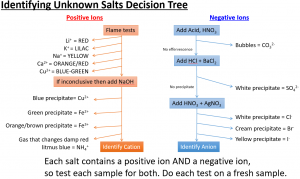
Testing for ions – summary

Here is summary of “testing for ions” (otherwise known as qualitative analysis). These “tests for ions” are commonly asked in iGCSE Edexcel Chemistry.

Each ionic compound contains positive ions and negative ions. To use the decision tree, start at the top and if a test is negative then move down to the next test.
2019-05-13T15:14:50+00:00Categories: Uncategorized|Tags: , , , |
Select a set of flashcards to study:

     Terminology

     Skills and equipment

     Remove Flashcards

Section 1: Principles of chemistry

      a) States of matter

      b) Atoms

      c) Atomic structure

     d) Relative formula masses and molar volumes of gases

     e) Chemical formulae and chemical equations

     f) Ionic compounds

     g) Covalent substances

     h) Metallic crystals

     i) Electrolysis

 Section 2: Chemistry of the elements

     a) The Periodic Table

     b) Group 1 elements: lithium, sodium and potassium

     c) Group 7 elements: chlorine, bromine and iodine

     d) Oxygen and oxides

     e) Hydrogen and water

     f) Reactivity series

     g) Tests for ions and gases

Section 3: Organic chemistry

     a) Introduction

     b) Alkanes

     c) Alkenes

     d) Ethanol

Section 4: Physical chemistry

     a) Acids, alkalis and salts

     b) Energetics

     c) Rates of reaction

     d) Equilibria

Section 5: Chemistry in industry

     a) Extraction and uses of metals

     b) Crude oil

     c) Synthetic polymers

     d) The industrial manufacture of chemicals

Go to Top
